The Poetry of Movement
For those of you who do not already read The Master's Artist, I want you to go read this debut post by my friend Madison. Then come back and tell me your thoughts.
You're still here? Go! Go read it!
For those of you who do not already read The Master's Artist, I want you to go read this debut post by my friend Madison. Then come back and tell me your thoughts.
You're still here? Go! Go read it!
Okay, as I mentioned before, I have some unfinished Mount Hermon blogs to wrap up. First is a group of bloggers from Mount Hermon. We all met together one night for a Blog-o-rama, and shared tips and ideas on blogging. Here are the people who attended (and wrote their names/blogs down). Check out their blogs; there's some good stuff there.
Actual Unretouched Photo and The Amazing Shrinking Mom - Melodee Helms
Real Women Scrap - Tasra Dawson
Relevant Blog - Mary DeMuth
maxgrace.com - Bill Giovannetti
Christian Work at Home Moms - Jill Hart
Larry's Bible Blog - Larry Wilson
Parenting Solo Devotionals and Rebuilding Hackberry - Doug Mead
Moral Movies - Dean Anderson
Exploring Adoption - Laura Christianson
Writebrained - BJ Hamrick
Why didn't you warn me? and Sometimes I feel like a piece of bologna - Pat Sikora
Happy Feet - Jon VonHof
Goddess Worship - Susy Flory (who's doing a Christian investigation of goddess worship)
Mommy Life - Barbara Curtis

My friend LL recently posted another agricultural concept over at Seedlings in Stone, this time on the practice of fallowing. We usually think of allowing a field to go fallow as doing nothing to it: letting it rest. In actuality, a farmer still conducts activity in that field; it is just not focused on producing a crop but on restoring nutrients and improving soil structure.
As I ponder this post and what it means to my life, I see that whether you are planting a crop or allowing the field to go fallow, you are working the field to be productive. It is not a time of idleness in either case. The end goal is the same. As we live in a society that expects immediate results, we are often unwilling to take the time to tend our field if it will not produce a crop. We see many examples of people skimming over appropriate preparation so they can get the “doing” of an activity or project. Sometimes it works out okay, but often without the proper foundation things eventually fall apart.
The other thought I had about this was perhaps my goal as a Christian is to focus on being fallow. My priority is to abide in Christ and grow closer to Him, and that restores the nutrients I need to grow and builds the soil structure I need to serve. It’s his job to do the actual producing of fruit in my life. I’ve thought about this concept a lot recently. I have heard many speakers and read many books that basically say to pick a fruit of the Spirit and work on improving that area of your life. While I do not disagree that it is important to be aware of how those fruits are manifesting themselves in your life, I do not believe we are supposed to work on them. We are told to abide in Him and HE will produce the fruit. We don’t have the ability to produce the fruit on our own. (And as my friend Sarah pointed out, did you ever notice that it is not the “fruits” of the Spirit, plural…it’s fruit, singular. They can’t be separated.) So maybe we should leave the crop production up to God and work on being fallow, so that when it’s time to produce a harvest, our soil is ready.
Photo: Countryside in Rwanda (2004)
My friend D'Ann has entered an online contest for fiction writers. Register on the site here, and then check out her first chapter of Monkey in the Middle and give her a rating. She is being judged by the ratings as to whether or not she moves on to the next level of the competion. You have to register to read and vote, but it is free. Good luck, D'Ann!


My friend LL Barkat, over at Seedlings in Stone, recently began a series of posts on an agricultural book that she is reading. As usual, LL does a great job of applying seemingly unrelated topics (like farming techniques) to our every day life. Since I’m behind in commenting on her blog – and since I realize I have more to say about her topics than is probably appropriate for a comment – I’ve decided to blog on the topics here.
Her second blog explained a concept called “Smallness of Scale”. Basically, the technique of using smaller farms permitted attention to be acutely focused, with the proper attention paid to the details. LL offers some great thoughts and practical ideas for implementing “smallness of scale”, as do her readers. Overall, the idea that “less is more” is promoted.
I loved that thought and the ideas that accompanied it, and am still pondering the idea about really focusing on a smaller number of relationships, rather than many. However, one reader’s comment really struck me: Marcia said, “Tiny moments or gestures of love make me happy, small steps are big steps in my eyes, I love 'stolen moments'.” I loved that interpretation. I immediately remembered something Beth Moore said in a conference I attended yesterday (more specifically on the conference in a forthcoming post) – “God doesn’t just have the power to change our lives, He has the power to change our day.” We keep looking for God do something way out in our lives (think big), and we miss the ways and the opportunities that God wants to do something in our today (think smallness of scale). Small things happen every day that are blessings or encouragement or learnings, and if we’re always looking for that big thing – we’ll miss out on so much. Likewise, performing those small deeds of kindness and love are just as important and just as powerful (if not, sometimes, more) as those huge, outrageous acts of love. It’s amazing the response I receive every time I drop a friend a little note of encouragement in the mail, or send her my prayer for the day for her in an email or call her up just to say that I’m glad she’s my friend. When I pay attention to little things that make my husband’s day easier and that encourage him and that communicate that I love him – just little things – they touch his heart deeply and motivate him.
When I think of smallness of scale in this way (in addition to the less is more perspective), I realize it is so easy to implement. Small things seem manageable, easier to fit into my every days.
For more on Smallness of Scale, check out LL's blog here .
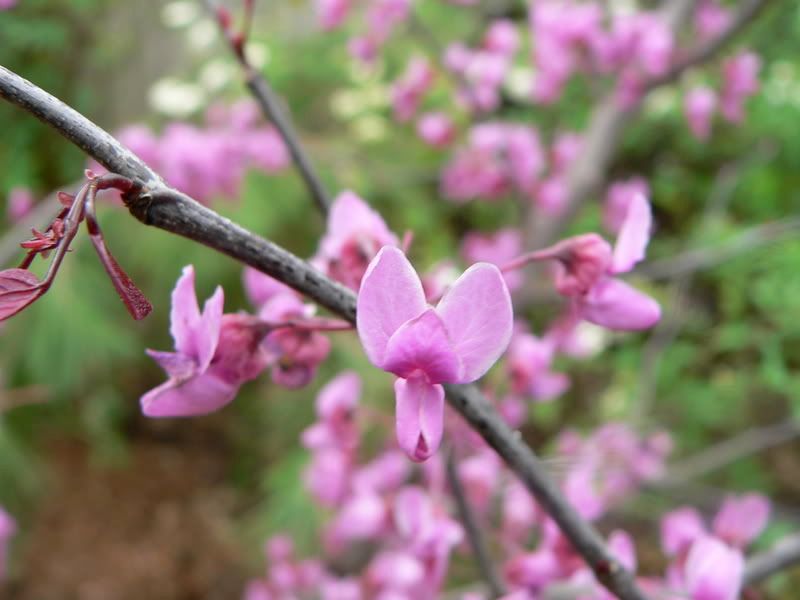
Photo: Crossvine in Sue's backyard, 2005
I've posted over at Headline Girls to catch up on my articles. There's even a nice little haiku, for those poetry fans. I'll be back up and running on my blogging this weekend! Stay tuned!