Showing posts with label christianity. Show all posts

6/19/07

Restoring Community - Part II

As I continued to ponder the answer to the question, “How?”, I finally came to the point that it had to start on an individual by individual basis of casting a vision of what community could (and ought) to be, getting people excited about it and then brainstorming/working together to figure out how it practically works out. But how do you even start with that? My thoughts naturally went to community groups (our church’s name for small groups or mini-churches or home groups, etc). If transformation is going to ripple through our church, that's where it will start. After all, "community" is in the title, right? But part of what I see right now is that community group really means Bible study group. Not that some groups aren't growing deeper in relationship, but I don't sense they are intentionally striving to be community.

Which then begs the question of what would it look like on a practical level to be community? So, here's what I thought about. Keep in mind that I am not trying to propose anything...especially not a program. It just helps me to categorize my thoughts. And, well, it just so happens most of them start with the same letter.

Sharing stories
Study
Serving one another
Stretching
Struggling and Celebrating

To avoid having a super long post, I'll probably take the next few days and post more detail on each of these points. At least now you know where my thinking is headed, though.

These are just some initial thoughts. I’m realizing I have a deep passion for this topic, and I’m excited about being a change agent in my local church.

LINKED to this Post: Pat's comments on Why didn't you warn me?

6/18/07

Restoring Community - Part I

I’ve been reading a book by Shane Claiborne entitled The Irresistible Revolution (book review coming as soon as I actually finish it) and many thoughts have begun to swirl in my head, literally keeping me up at night. Among them is this concept of community that keeps coming back to me over and over. Claiborne is a co-founder of a group called The Simple Way. What attracts me to this group is their desire to practically live out what it means to be a follower of Christ, and therefore to be the Church. For them, it involves sharing their resources, viewing each other as family, seeing everyone around them (and around the world) as dear friends and creations of God and seeking to treat and serve them as such, standing up against injustices carried out against these friends and family, and worshiping God and growing deeper with Him, together.

To me, that’s what community is all about. We were created to be relational, and we were created to be in community. I long for true community in my church. I desire to live out community in our world. Dick Staub talks about being ambassadors and building bridges. Another book I recently read, Same Kind of Different As Me, also discusses what it means to live the Gospel and intentionally seek relationships. Blogs like Charity’s are challenging me to evaluate how good a steward I am of every aspect of my life. My thoughts are churning: where do I go from here?

I’m considering what all of this means in terms of outreach, and I have some thoughts I’ll share later on that. What strikes my heart deeply today is how can I effect transformation in my local church? Don’t get me wrong; I love my church. I love our vision of being authentic Christians. I admire our pastor who continually challenges us to live as followers of Christ, covered in the dust of our Rabbi. But true community has to come out of more than just a great vision statement or an inspiring sermon. I appreciate what Shane Claiborne has done in creating a new community. His efforts have begun a movement that is spreading across this country (and the world). I think that’s wonderful, and I hope it continues to do so. At the same time, I believe that same kind of community can - and must - occur through transforming the existing church. I firmly believe the church I attend can become that kind of community. The million dollar question I’m pondering, of course, is how.

LINKED to this Post: Pat's comments on Why didn't you warn me?

5/17/07

Book Review - Wishing on Dandelions


And while we're still on the topic of dandelions...here's a book review that I've been meaning to post, and now find it quite appropriate to do so.

If you are looking for a book that stirs your emotions and keeps you up until the wee hours of the morning, then I highly recommend Wishing on Dandelions by Mary DeMuth. WOD is the sequel to DeMuth’s debut novel, Watching the Tree Limbs. Although it took me a little longer to be drawn into this second book, it surpasses the first. WTTL focuses on redemption, and as a natural progression, WOD focuses on learning how to accept God’s love and growing deeper in understanding our redemption.

I found this story heavier that the first book, despite the fact that the main traumatic events occur to Maranatha in WTTL. For me, I identified on a deeper level with the struggle to fully grasp and accept that God loves me despite all my faults. While I enjoyed the first book, I connected more with the second. I appreciated the new characters Mary introduced as well. Some of them I liked immediately, and only wished to know them more. Some of them had to grow on me, but the more glimpses I got into their hearts, the more I wanted to know about their back stories. Still others I appreciated for the reality of their humanity. One character in particular I really thought was going to have a change of heart after he heard Maranatha’s story, but he didn’t. In fact, the depth of the judgment in his soul only became more evident. At first I was appalled, but then quickly realized that people like that do exist and therefore have an appropriate - even necessary - place in a novel like this.

One of the many things I enjoy about Mary’s writing is that while she is a Christian author who discusses Christian values and issues, her books do not feel “Christian.” Do you follow me here? Writing a great story is what comes first for Mary, not writing a Christian story that she hopes is great. Of course, Jesus pours out onto her page, but that’s because He’s so pervasive in her life, not because she has an agenda to write about Him. I applaud her for writing reality, writing authentically and writing with excellence. It’s no wonder she’s nominated for a Christy Award.

5/15/07

Book Review - The Culturally Savvy Christian

*Updated* So really, you don't have to read the book first to comment...if you have any thoughts or reactions based upon what I shared with you about the book or from the quotes, I'd love to hear them!

When was the last time you read a book where you felt like you underlined most of it? For me, it was Dick Staub’s latest book, The Culturally Savvy Christian. I enjoyed Staub’s passionate appeal to Christians to be deep in their faith and relevant to society, both. He leaves no room for it to be an either or decision; it is both.

The underlying premise of the book is encapsulated in this quote:

We live in a superficial popular culture, soulless, spiritually delusional, and driven by celebrity. Today’s Christianity has taken on those same qualities. Because we are created in God’s image, with spiritual, intellectual, creative, moral, and relational capacities, we will never be satisfied with a superficial, mindless culture or religion; the result is that religious and irreligious people alike are experiencing deep spiritual hunger.


Staub then goes on to lay out his response to the question, how then do we change?

1. We must be deep Christians, drinking deeply from the living water, making God the central importance in our lives and the cross the center of our personal story.
2. We must become fully human, which to Staub means allowing God to restore us to His original intent - not salvation or the evangelism of others, but to glorify Him through reflecting His image. This requires that we present our bodies as living sacrifices to Him, stop conforming to the world and renew our minds. Staub also points out that “our call to become fully human is a direction, not a promise of perfection.” We are not done with our changes until we reach heaven.
3. We must love others with an unconditional, transforming love. That love should be embodied in our actions, ideas, beliefs, our public and our private lives.
4. We must be discerning about culture, “discovering points of disagreement between our faith and culture by listening to both, then choosing a path that pleases God.” We must practice “selective acculturation, allowing ourselves to experience resonance with art that connects us with the joy pain and realities of our fellow humans, while also identifying and guarding against dissonant values, ideas, belief and behavior.”
5. We must build community with other believers, because we are all aliens in this world. We long for a place to be encouraged, to fellowship and to belong.
6. We must observe the culture we live in (almost like anthropologists) so that we can find the most effective entry point for each person or group and communicate using an appropriate language and illustrations. We must also care deeply about people. We bridge cultural knowledge to our Christian experience and understanding.

Staub ends with a chapter to artists and creatives, saying they will lead us into the “cultural renaissance” we’ve been waiting for. He offers some good insights and advice to artists (used broadly), particularly around being authentic and striving for excellence, not just trying to be “Christian.” He offers a quote from CS Lewis saying “we don’t need Christian writers, we need great writers who are Christian.”

If I had to cite anything negative about the book, it would be that Staub uses an overwhelming number of quotes (albeit some great quotes), and sometimes references the same quote multiple times. During the first section of the book, he comes off as a little preachy, but I chalk that up to his passion for the topic.

I was pleased that he offered solutions, not just complaints about society and Christianity. I also appreciated his unwavering support of being strong in your faith, and at the same time understanding the culture.

I highly encourage you to pick up this book and read it. When you do, come back and tell me what you think. Personally, I’m excited and energized about being a “culturally savvy Christian.”

A few more quotes (among many, many) I appreciated:
“People who believe they know the truth need to realize that cultural influence requires more than knowing the story; it requires telling it thoughtfully and artistically. Never has there been a greater need for wise, gifted storytellers who understand the story we are in and can communicate a better way gracefully and truthfully.”

“Today, the toughest test we can apply is to ask whether the media items we consume represent the highest and best spiritually, intellectually and aesthetically.”

“Culturally savvy artists do not expect their work to be accepted because they are Christian, but because their art is good.”

4/25/07

An Interview with BJ Hamrick

I met Bekah at Mount Hermon and immediately fell in love with her sweet personality and humble spirit. It amazes me that she’s still in college, and yet so accomplished and focused. She’s been writing for about six years professionally and was recently engaged to her amazing boyfriend, Ethan. She currently lives in North Carolina. I hope you enjoy getting to meet my friend, BJ Hamrick.

*What is your passion in life?
Last winter, I lay on the floor and watched the snow hit my window. Little pellets of ice... when they made contact with the window pane, they melted into tiny trickles of water.

That's the way I want my life to be.

I want everyone who comes in contact with me to be forever altered.

But I can't change their lives. I'm only the window pane... and God is the heating force behind that pane.

I want Him to give me His passion... His warmth... His love for the world...

*What was your main takeaway from Mount Hermon? How are you going to apply it in your daily life?

The biggest thing I learned at Mount Hermon was how to fish.

I know this sounds crazy, but let me explain.

The day before I got to Mount Hermon, I got a rejection from a literary agent who was going to be at the conference. "It's not about you," he said, "It's about me. I don't do books for teenagers."

"Are you breaking up with me?" I asked. "Because this sounds more like a breakup letter than a rejection."

Anyway. What does this have to do with fishing?

I was feeling discouraged after the breakup/rejection letter, and decided I wouldn't pitch to any agents at all during the conference.

Poor, pitiful me.

The fourth morning of the conference, I woke up and started to read my Bible.

It was the story about the disciples when they had been fishing all night without any success.

"Cast the net again," Jesus told them.

"But LORD," the disciples whined, "we've been fishing all night."

Apparently they realized Jesus was serious, because they decided to cast the net again. Out of obedience to Him.

As I read, God spoke directly to my heart.

"Cast the net again," He said.

"Excuse me?" I asked.

"You heard me," He said. "Cast the net again. Talk to another agent. Put yourself out there."

That night I sat at dinner with a literary agent whom I had been praying about pitching my books to for 2 years (talk about working up the nerve).

The moment I gave my pitch, the agent handed me her business card and told me she wanted to hear from me. Last week, she sent me a contract.

When I think about it, I'm amazed that I almost didn't obey. That I told the Lord I was tired. That I wasn't willing to cast the net again.

The biggest thing I took away from Mount Hermon was that God doesn't call us to fish without first giving us the strength to do what He's asked.

*How has being a writer impacted or informed your daily life as a Christian?
It overwhelms me -- every day -- the sense of responsibility God gives me as a writer. When my life is not in line with what He wants, it shows in my writing. My lack of relationship with Him affects not only me, but also those for whom I write.

*I hear you have some exciting news in your life. Care to share?
About one month ago, I was out on a walk with my boyfriend. We were off the beaten path when he got on one knee and asked me to be his little wife. Well, he didn't say it quite like that -- it was much more eloquent. And of course I said yes!

*What are you most excited about in being married? Most concerned about?
I'm most excited about spending the rest of my life with my best friend. I'm most concerned about not being able to express to him exactly how much I love him. Some days, it's just impossible to convey how much he means to me. There just aren't enough words... and I'm a writer.

*I'm doing a talk about envy next week. Just for fun, what's the silliest thing you've ever been envious about?
I am completely envious of Mary DeMuth's hair. Seriously. How in the world, when you're camping at Mount Hermon, can you get your hair to look that good? It's a mystery to me.

4/19/07

An Interview with Mick Silva


As promised, here is my last interview from Mount Hermon. I met Mick two years ago through my friend Jeanne. Besides just being an all-around nice guy, I was struck by his authenticity and genuine interest in people. At the time, I was feeling overwhelmed and way out of my league. I met with Mick to ask my naive little questions, and he made me feel like I was just as important as the accomplished (and published!) writers around me. As I've gotten to know Mick better through reading his blog, I also appreciate his challenging insights and thought-provoking comments. I hope you enjoy getting to know him better as well.

Mick Silva
Editor, married for 6 years, has 2 girls, been writing since age 17, currently resides in Colorado Springs, CO

How has your job as an editor impacted your spiritual life?
Just as a composer creates an emotional tone, I like to think I help create an emotional tone within an authors’ work. My passion is to guide the message of other writers into its greatest form, helping draw out the greatest ability to connect. This process is all the better if the writer is someone who understands that and gets the spiritual implications. As an editor, I am humbled to be entrusted with the task of guiding these authors. It’s almost like the role of a pastor—which is scary when I think about incurring the judgment of James 3:1 (“Not many of you should presume to be teachers, my brothers, because you know that we who teach will be judged more strictly”). But in Christian books, we are all teachers in some respect. It’s a heavy responsibility to stand before God with that. Yet this process of helping writers see what they’re missing grows me because I have to hone in on the core of the writer’s message and help them streamline their words so the reader connects quickly. Practicing this teaches me how to stay in the moment. It translates into efficiency in life—with conversations, emails and phone calls, in prayer or Bible reading time, just get to the core issue. But in order to do that, I can’t rush ahead of God. I have to stay on my knees to receive guidance. Overall, I think being an editor has made me do this more with gratitude and humility.

Palm Sunday celebrates the entry of Christ into Jerusalem. How do you celebrate His entry into your life?
My life forever changed when we had kids. I became a different person, particularly as I learned about humility. Christ was hailed as the great leader who would lead everyone into great power, but he rode in on a donkey on a road paved with palm branches and coats - the only things the people had. My kids serve as a constant reminder to me that I am not all that. We don’t all have these huge things to offer to God. I try to enjoy Him in what He is already doing. I celebrate that with my kids, telling them what I feel about them. I’m also keeping journals for my daughters about what God has done in our lives. I try to focus on humility.

You’ve talked a lot about humility. What brought you to this focus?
My cursed pride, of course! (Laughs.) Pride is one of the things that keeps us from experiencing the true spiritual gifts and rewards that God has for us, that he wants us to understand. We can’t experience everything He has for us unless we come with open hands. Pride makes up two of the three great sins, and yet we don’t focus on it much. We think we have to be strong (this victorious Christian living concept), and we use that as a license to be prideful. We need a willingness to be humble before God and others, otherwise you will never get past that starting point. I constantly need that reminder. The other part is that you give yourself worth from where God is leading. Your self worth is given to you through God’s work in real life, so when you’re trying to get it from this false sense of confidence - or whatever - that’s not really where you need to be. Ironically, God is a humble God. He came to us as a man, and we are to accept him willingly in the same spirit He had. The exciting part is we can come to Him directly. He wants to be a part of us, to fill us, and that gives us so much self- confidence. We need that connection to see how He sees us. For me, that’s the beginning of everything.

At this point in the conference, a sense of weariness is often setting in. How do you keep from getting weary?
I never have a problem keeping interested when I’m connecting, when I’m really getting at what the core of the message is with an author. It is tiresome when most of us are introverts, and yet we’re talking all day long and being “on” all the time. But I deal with it by not being “on” (again, related to humility thing) and being honest connecting with people. You don’t have to have this facade all the time. Having a good time is not tiring. I try to stay relaxed and in the moment. I must constantly remind myself, but it’s gotten easier. And that sustains you: love people, learn to listen and connect with them. That’s energizing.

As Christians, particularly Christian writers, we sometimes tend to be inwardly focused on our circle of like-minded people. Why do we create these Christian bubbles?
We’re strangers; we’re not accepted in this world and Jesus’ radical message is off-putting. It’s hard to be out in the world and be pushing - worse yet, peddling - the Gospel. We come to places like Christian conferences to refuel and recharge. That’s not bad; we need to do that. However, we also need to be aware that where we live gives the world a perception of who we are. If we isolate ourselves and don’t have a lot of contact with those who aren’t Christians, we create an impression that we don’t like non-Christians.

So, how do you and I make a change in that perception?
Do it personally. Be humble and grateful. We trust God that we can go out and have an impact through how He has gifted us and through our personalities. By employing these things he’s given us and within community, we become the hands and feet of God. We then use our restorative times (like Christian conferences) to actually equip us to then go back out. That requires trusting Him that He will be there. We don’t have to be afraid to go out and say what needs to be said because we are equipped with the Holy Spirit. We often think it’s presumptuous to say the Holy Spirit spoke to me, but that’s not true. He speaks to every Christian and employs us to spread the gospel to everyone. We don’t believe it happens because we aren’t actively doing it. But with just doing it, we take baby steps forward.

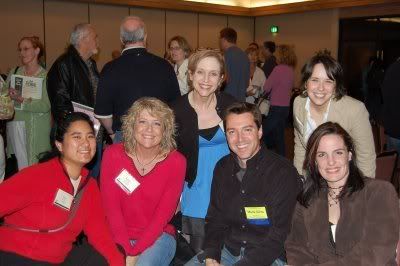
Photo: Me, Leslie, Jeanne, Mick, Bekah, Madison (2005) Credit: stolen and used without permission from Jeanne although I think TJ actually took the picture!

4/10/07

Galatians: Week 2

Galatians 1:6-10

I am astonished that you are so quickly deserting the one who called you by the grace of Christ and are turning to a different gospel, which is really no gospel at all. Evidently some people are throwing you into confusion and are trying to pervert the gospel of Christ. But even if we, or an angel from heaven, should preach a gospel other than the one we preached to you, let him be eternally condemned! As we have alraedy said, so now I say again: If anybody is preaching to you a gospel other than what you accepted, let him be eternally condemned! Am I now trying to win the approval of men, or of God? Or am I trying to please men? If I were still trying to please men, I would not be a servant of Christ.

I've just started memorizing this section (again), and it's not coming back as easily as the first five verses. I actually must be intentional about memorizing it, which is probably better anyway. Here are a few thoughts that strike me about this passage.

1) I am ASTONISHED...I want to be in the place where Paul is - so in love with Jesus and following hard after his teachings that it would astonish him that someone was distracted by a different gospel. Personally, I get distracted all the time, so it's not really astonishing to me to think about it happening to others. But Paul can't even imagine why someone would desert Christ because he is walking so closely with him - and may I go so far as to say, experiencing the abundant life that Christ had for him. I need to get to that place.

2) Okay, it might be just me, but I'm thinking Paul was serious in his admonition to pay attention to the gospel being preached. Eternal condemnation doesn't sound fun to me. Of course, in this text he warns the Galatians to beware of those "throwing them into confusion" but I like that he then switches focus momentarily to warn those who are doing the throwing into confusion. In the same way, we need to test the preaching that we hear against the Word, AND we need to be careful about the gospel we spread as well.

3) The last verse in this section is one I think of often. It's easy for me to get caught up in focusing on the approval of man...and it's definitely something I crave. But it's not eternally significant, and that's the type of impact I want to make. I can't please man and be a servant of Christ at the same time. Sure, sometimes it coincides, but pleasing man should be a pleasant by-product, not my focus.

Anyone have any thoughts on this passage they want to share?

4/5/07

An Interview wtih Marilynn Griffith

At Mount Hermon, I had the opportunity to meet some amazing people, with wonderful stories to tell. I first saw Marilyn from across the room, and her smile immediately captured my attention. Her warmth and laughter attracted me, and I was determined to meet her at some point. I had the privilege of sitting at her table during lunch one day, and I asked her for an interview. I hope you enjoy getting to know Marilynn a little bit. I am currently reading her first book Pink in the Shades of Style series.

Marilynn Griffith
Freelancer, married for 16 years, has 7 kids, written for 7 years

What is your passion in life? Being a good friend, helping people be good friends, learning how to juggle all these things of womanhood (being a mom, a sister, an aunt, etc) and maintaining some sense of self, helping others figure out how to hold onto family and Jesus in one hand and their dreams in another.

How have you managed to do that in your life? I have a great husband. I enlist my kids to work with me as a team. Everyone works together as family; we see it as a family business. My kids participate in achieving those goals, so when a check comes in the mail we all celebrate.

What do they think about being a part of those goals? Sometimes they get tired of it, but really they love it. They give books to their teachers. When people ask them what their mom does, they love it to say I’m a writer. Of course, it has its ups and downs.

How has writing affected your spiritual life? Wow. I think that I didn’t realize how safe I was as a Christian. My writing voice wasn’t established as a christian, so my writing was raw but Jesus was there. I didn’t realize how many safe things I implemented in my life. I discovered a bigger Jesus - scary, but good, even though everything doesn’t always have a happy ending. God is still there, even if you don’t get anything you prayer for. It was a big self-discovery.

As Palm Sunday approaches, how do you celebrate Christ’s entrance into your life? At home we would attend a sunrise service. As a child, we used to even receive palm branches and wave them. I use the time to look back on the year and meditate on all the things God is showing me. It’s like a guidepost to stop at and evaluate whether I am moving toward Jesus or coming away. It’s a sort of new year, and a chance to give back that lordship that I might have taken.

Anything additional you’d like to add? I love to meet new people and hear from people. So if you are interested in reaching me, you can find me at my website: http://www.marilyngriffith.com or email me at marilynngriffith@gmail.com.

An Interview with Kay Marshall Strom

I met Kay two years ago, at my first Mount Hermon conference. She encouraged me greatly with her heart for the global Body of Christ, and her courage to travel around the world to gather the stories of persecuted women. She's written an awesome book called Daughters of Hope that I highly recommend. I'm pleased to introduce to you, Kay Strom.

Kay Marshall Strom
Freelancer, married for 8 years, written for 20 years, currently in Santa Barbara, CA

What is your passion in life? Actually, it has come out of my writing. My passion at this time is letting believers in this country know that they are part of the global family of God. They need us as much as we need them. It pains me that we don’t realize we’re part of a bigger family. Being a part of the Body does not just mean that we need to help our brothers and sisters around the world, but to realize that we need them just as much. We think we’re just depriving them, but really we are depriving ourselves, too. And we are depriving the Body of God.

How did this come about? That’s actually an interesting story. I love to read historical biographies. I was reading the story of Marie Antoinette. It’s amazing, she’s not as hard hearted as we think; she was just totally clueless. She had all the royal people over for a banquet, and there was so much food the tables were sagging - all while people in Paris were starving. After everyone left, she turned to the Emperor and said, “Let’s not throw away all this food, let’s spread the leftovers on the sidewalk.” As they stood and watched the people lick the sidewalk so as not to waste anything, she said “We are so good for the poor; they should love us.” The poor people of France heard this, clenched their fist and resolved to have her head. A week later, 9/11 occurred. At church on Sunday, an elder in church stood up and talked about the need to pray for the families of those who had lost their lives. Then he shared that he didn’t know how this could happen. “We are so good to the world, everyone should love us.” And I thought, we’re just like Marie Antoinette, and the world is going to have our heads. That became the inspiration to write Daughters of Hope (Kay’s book sharing stories of women around the world who are persecuted for their faith). I was in India interviewing women for my book, and as I normally closed my interviews, I asked if there was anything else someone would like to say to me. They asked me if I had ever been kicked out of my house for being a Christian, thrown rocks at, persecuted, hated, denied food for being a Christian. I answered, “No, we just don’t face that type of attack in the US.” Then they asked me if we did have to suffer, would we still be Christians? And I thought for a long time, and didn’t know how to answer. They said they would pray for strength for us. They would pray that if we did have to face persecution that we would endure it. And they asked me to tell everyone I spoke to that they were praying for them. When I am asked to speak - even at Rotary meetings - I share their story.

How has your writing affected your walk? It has changed it totally. It has changed my perspective on life and death, on my purpose in being here. The biggest battle is being patient with others. I know other people haven’t been where I’ve been. We complain about things here, but we’re so fixated on the wrong things. It is so hard to be patient with what I see in the American church. When you go and see, you can’t come back and be the same. I will never to my dying day, get out of my mind the pictures of the people in Sudan - the most wonderful people in the world - who bounced back despite the most incredible things. When I talked with them, they asked me, “Does anyone care about us?” No one asked me for money, they asked me to pray for them. They requested we pray for their children that they will stay firm to the faith (aka be willing to die, be persecuted). When we left them, they ran behind our bus as fast as they could for as long as they could keep up, saying “Pray for us” and then they disappeared into a cloud of dust. I still see that image in my mind. If only we would truly partner with our brothers and sisters around the world.

As Palm Sunday approaches, how do you celebrate Christ’s entrance into your life? I remember reading through the Bible as a 13 year old, trying to figure out how to get it all together, when I came to Micah 6:6-7, “With what shall I come to the Lord and bow myself before the God on high? Shall I come to Him with burnt offerings, With yearling calves? Does the LORD take delight in thousands of rams, In ten thousand rivers of oil? Shall I present my firstborn for my rebellious acts, The fruit of my body for the sin of my soul?” And then comes the answer in verse 8. “He has told you, O man, what is good; And what does the LORD require of you But to do justice, to love kindness, And to walk humbly with your God?” That’s how I celebrate and pray to celebrate - to act justly and to love mercy and to walk humbly with my God.

3/27/07

GHR: Who Is God - Christ is Sufficient

For me, the sufficiency of Christ was the most profound lesson I learned on our trip. Let me approach this from a couple angles.
1) As I mentioned in my last post , we expected to minister to the people we encountered. After all, we were from the United States. We own plenty; the Africans have little. I don’t think we realized the arrogance of our mindsets until we realized how little we did have to offer. For one, the needs are so overwhelming that we didn’t even know where to begin. Additionally, we found ourselves being served more than we were able to serve. Families sacrificed their only meat for the month, so we could have a meal that we didn’t need. Our hosts gave us chairs, while everyone else sat on the floor. Children serenaded us with songs prepared in advance for our arrival. It impacted all of us deeply. I was completely humbled by the fact that I had absolutely nothing to offer, although I thought I was going to be some sort of hero, serving them. All I had to offer was Christ, and He was sufficient.

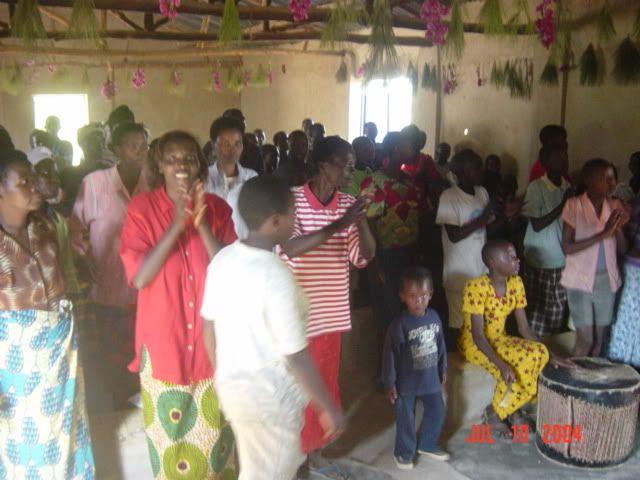
2) We visited many Christian communities during our visit. One such group was a church comprised of people suffering from HIV/AIDS. They banded together as a community because their communities had rejected them. In East Africa, AIDS is a socially isolating disease, which is a major part of the problem. Several people shared their testimonies with us. They talked about the lack of access to proper medications, the lack of food to eat - not only so they wouldn’t be hungry, but so the drugs they were able to take didn’t make them sicker, the lack of clean water and the lack of love from their families and former communities. But I don’t believe they shared these problems with us to gain our pity. Their testimonies didn’t stop there. They talked of their love for God who watches over them, who cares for them when no one else had and who they can’t wait to see when they leave their earthly bodies. Then they sang praises...praises from the lips and hearts of people whose God is sufficient for them. As our group debriefed that evening we could barely talk about our experience. As I sit here and type this, I can hardly keep from becoming emotional all over again. From an earthly point of view, these people had no reason to be joyful, and yet their love, their joy and their hope was more profound than ANY place I have ever been. He alone is sufficient.

3) Lastly, the so-called title of this little blog series came from my lowest point during the entire trip. I lay on my bed in a grass hut in Sudan, and it was about half way through the trip. I saw and experienced so much in those first three weeks and the weight of it all began to press down on me. I cried out to God, “I can’t do this, Lord. I don’t know how in the world to love these people. They are nothing like me. I have nothing to offer them. I can’t live in a grass hut. I miss running water. I don’t like the bugs. I’m tired. I don’t know how to even make it through the rest of this trip.” And I recalled the verse in Philippians, chapter four. We often quote verse 13 (I can do all things through Christ who strengthens me) as a sort of mantra that “we can do it”, but we pull it out of context. Verses 12-13 say, “...I have learned the secret of being content in any and every situation, whether well fed or hungry, whether living in plenty or in want. I can do everything through him who gives me strength.” What is Paul saying? Christ is sufficient. He is sufficient in any situation we are in, and His sufficiency is what gets us through.

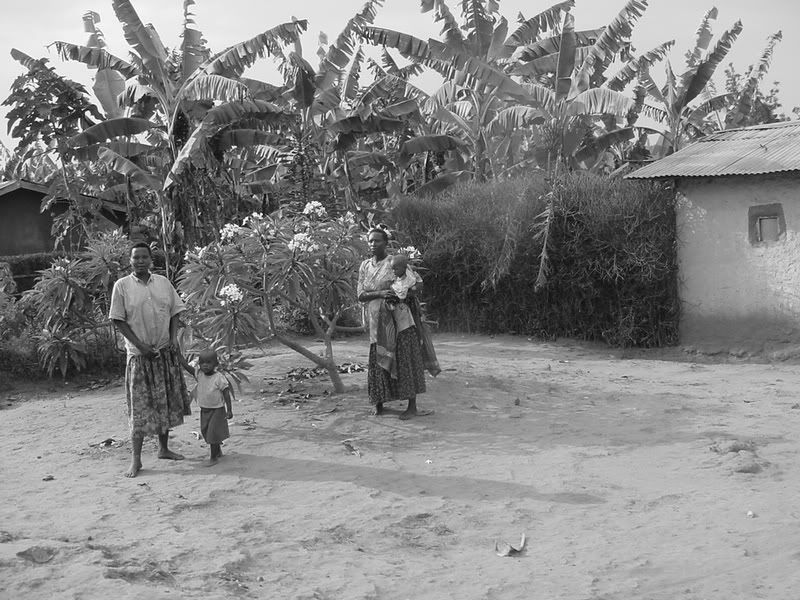
I know this is a long post, but this lesson was monumental to me. I’ll leave you with a few pictures and words that I shared during our reports back to the churches who supported us. I’d love for you to comment on how you have found Christ to be sufficient for you.


Where we expected to find despair...we found HOPE.


Where we found death and sorrow, we also found LIFE and JOY.


Where we found the fatherless, we found the FATHER.


We found that we are inadequate. We have nothing to offer ourselves, but Christ is SUFFICIENT. Philippians 4:12-13

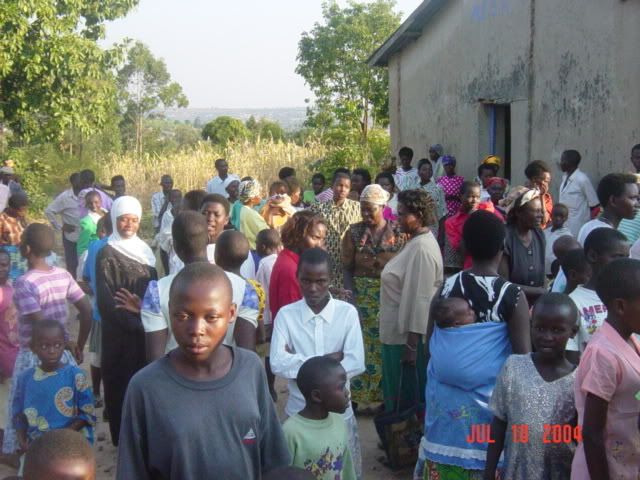
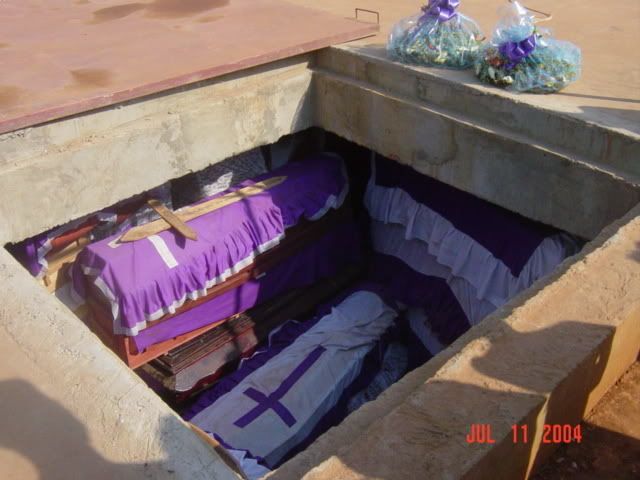
Photo: Church service at AIDS church, Rwanda (2004); Congregation at AIDS church, Rwanda (2004); Genocide Memorial, Kigali, Rwanda (2004); Coffins holding at least 10 people each from genocide, Kigali, Rwanda (2004); Street children, Rwanda (2004); Sudanese orphanage, Sudan (2004); Family watching, Rwanda (2004)

3/12/07

Book Review - Watching the Tree Limbs

It’s been a while since I sat down to read a book that I could not put down. Watching the Tree Limbs is exactly that type of book. Author Mary DeMuth hooked me from the moment the book opens with “Folks like my friend Camilla have lofty goals before they die, like stealing a kiss from a movie star or seeing the Sahara. Mine’s quite simple. I want to tell my story unsevered, as if it was actually me walking the sweltering pavement of Burl, Texas.” Half-way through the book, I purchased the sequel because I knew that I was not going to be able to wait to start the next one once I finished.

What I love about Mary’s storytelling is that she paints a poignant, beautiful picture of redemption and Christ’s unconditional love without feeling like it’s preachy or spoken with an ulterior motive. Certainly, Mary desires to share her faith through her words, but she chooses to show, rather than tell. The redemption story is so woven into the development of the characters and the movement of the book, that you can’t separate it out and say, “here’s the author’s agenda.” In fact, it’s the way I think my friend Mary lives her life: you can’t say, here’s the spiritual part of Mary’s life and here’s the rest. As a result, I feel comfortable - even encourage - recommending this book to non-believers.

But have no doubts, just because it’s “Christian fiction” does not mean that it is not a good story. Mary uses her words like a paintbrush on canvas, encouraging the reader at times to simply marvel at the intricacy of details and overall artistry of the story. I laughed, I cried and I connected with the characters. I couldn’t read fast enough, and yet wanted to savor every word. I won’t share much about the story itself; I’ll leave that to you to experience fresh. Know that Mary addresses some tough issues, and at times she reaches out and squeezes your heart just enough that it aches, but that pain only leads you to a greater appreciation for the redemption offered to the characters in the book (and to us, through Jesus Christ).

Please don’t think I gush just because Mary is my friend. If I thought her book stunk, I would let you know. But I don’t, and knowing her heart just makes it that much sweeter to recommend it to you. Mary graciously agreed to answer a few questions for me to post here, so I will leave you with our short little interview.

1) What has Maranatha taught you about redemption?
She has shown me that it’s possible to be redeemed even when life looks pretty bleak. God stoops best when He stoops to impossible situations like Maranatha’s.

2) What do you hope readers walk away from your book thinking about and feeling?
I hope the story sticks with them, that they can’t get it out of their heads. I hope they’ve been challenged in their perception of God and people. I pray they want to live better, more Jesus-breathed lives, having experienced the lives of the characters in the book.

3) Have you re-read your book since you wrote it? If so, does any character or scene strike you differently or teach you something new? If not, why not?
I’ve re-read the intro. Of course I pick it apart, wondering if I should’ve used this word or that. I recently received an email from a reader who lamented she’d not turned in someone who’d attacked her. I’d forgotten about the courtroom scene where Maranatha does just that. I’m thankful it had an impact, but I also hope that readers will know it’s never easy to tell about abuse.
4) Do you feel like you view life a little differently, now that you have interacted with Maranatha and the characters in WTTL? If yes, how so?
Yes. I always wanted a Zady in my life, but never had one. Now I want to be one. I hope I can be one.

5) On a personal note, what do you feel like God is teaching you during this season of Lent, as we prepare for the glory of Easter morning?
Mainly just the loss of it all. I again am struck with the reason Jesus was crucified. It’s a fascinating study if you look up the word envy or jealousy. Several times in the NT, the Pharisees are seen as being envious of Jesus. We think envy is no big deal, but it’s huge. HUGE. Envy crucified Jesus!

3/9/07

Preparing the Soul


My friend LL recently posted another agricultural concept over at Seedlings in Stone, this time on the practice of fallowing. We usually think of allowing a field to go fallow as doing nothing to it: letting it rest. In actuality, a farmer still conducts activity in that field; it is just not focused on producing a crop but on restoring nutrients and improving soil structure.

As I ponder this post and what it means to my life, I see that whether you are planting a crop or allowing the field to go fallow, you are working the field to be productive. It is not a time of idleness in either case. The end goal is the same. As we live in a society that expects immediate results, we are often unwilling to take the time to tend our field if it will not produce a crop. We see many examples of people skimming over appropriate preparation so they can get the “doing” of an activity or project. Sometimes it works out okay, but often without the proper foundation things eventually fall apart.

The other thought I had about this was perhaps my goal as a Christian is to focus on being fallow. My priority is to abide in Christ and grow closer to Him, and that restores the nutrients I need to grow and builds the soil structure I need to serve. It’s his job to do the actual producing of fruit in my life. I’ve thought about this concept a lot recently. I have heard many speakers and read many books that basically say to pick a fruit of the Spirit and work on improving that area of your life. While I do not disagree that it is important to be aware of how those fruits are manifesting themselves in your life, I do not believe we are supposed to work on them. We are told to abide in Him and HE will produce the fruit. We don’t have the ability to produce the fruit on our own. (And as my friend Sarah pointed out, did you ever notice that it is not the “fruits” of the Spirit, plural…it’s fruit, singular. They can’t be separated.) So maybe we should leave the crop production up to God and work on being fallow, so that when it’s time to produce a harvest, our soil is ready.

Photo: Countryside in Rwanda (2004)

1/10/07

Letter to a Christian Nation

Yesterday, I sat down and read Letter to A Christian Nation by Sam Harris. Basically, it is his response to all of the hate mail he received from Christians after publishing his last book (The End of Faith). Although I'm sure not many Christians will read this book (and even Mr. Harris recognizes this), we should...because it is written to us. We should not be afraid to read books by people who hold a completely different viewpoint than us, and we should not write hate mail to them in response.

Mr. Harris makes some very good and important observations:
1) He begins with pointing out the fact that he, an atheist, and conservative Christians actually have some things in common. We both agree that either we are right or he is right...but we can't both be right. He is correct in pointing out that if we truly believe what our religion says, it leaves no room for us to allow for another way. He is critical of moderate and liberal Christians and their acceptance of all religions as acceptable paths to God.
2) He later points out that inter-faith efforts are pointless, since none of them(who truly believe in the tenets of their faith) are going to compromise on certain points of their ideology and values, and our core beliefs are not compatible.
3) That as Christians, we are sometimes so caught up in our "Christian values" and protecting them that we overlook the reality of suffering in our world. We focus on protecting ourselves even at the expense of the suffering of others.

On the whole, I agree with these observations. I don't agree with all of Mr. Harris' application of those observations, but I agree with the underlying point he is trying to make.

However, for such a seemingly intellectual man, I am surprised at the number of generalizations and definitive (always/never) statements that he makes without substantial facts to back them up. I had the overall sense that he was one of those people who is passionate about his beliefs and will argue all day over them, but that he is only using arguments and points that he has heard someone else use. His book does not lead me to believe he has done any real, objective, in-depth research himself. Sure he quotes some surveys, but he has clearly picked the quotes to support his opinions, not formed his opinions based upon the data.

Whether you agree with it or not, Lee Strobel's book The Case for Christ provides an excellent model for how to approach something like Christianity. If you don't trust Mr. Strobel, you could in the least follow his example (meaning, his approach) and conduct your own research. If I could encourage Mr. Harris to do anything, it would be to embark upon a research project like that. I'm not saying I think it would cause him to convert to Christianity, but I believe it would change his perspective on some of the issues he addresses.

The underlying issue that surfaces in Mr. Harris's book is the problem that most atheist seem to have: reconciling the concept of a loving, all-powerful God with the existence of suffering in the world. I agree this is a tough issue to face, but not one that is insurmountable. I also am pondering something my pastor mentioned to me tonight: that the issue atheists need to resolve is the existence of pleasure in the world. Why would it exist if we have merely evolved? Pleasure does not fit into the model of "survival of the fittest" and adapting to survive. And where would a desire for meaning and purpose in life come from, if not from a creator?

Anyway, this book offers some good insights and things for Christians to consider - about what we believe, how we behave and how we interact with the world. However, it is greatly lacking in any concrete, compelling reason to agree with Mr. Harris's assertion.