6/5/07

Snapshots

About two years ago, the movie The Man (starring Samuel Jackson and Eugene Levy) hit movie theaters with underwhelming success. True, it left much to be desired, and had I seen it in the theater I might have been disappointed I couldn’t get that money or time back. Admittedly, however, I found the interaction between over-talkative, naive fuddy-duddy salesman (Levy) and cool, but angry under-cover agent (Jackson) mildly amusing...even to the point of a few bursts of laughter out loud. One scene in particular remains lodged in my mind. Jackson commits some sort of questionable act or crime (I don’t remember) and tells Levy to get into the car. Before Levy gets into the car he looks at Jackson and slowly and deliberately blinks both eyes at the same time. Then he tells Jackson, “I’m taking a mental snapshot of you.”

I think about that scene periodically because sometimes I wish I could take real pictures I could keep forever from the perspective of my eyes. I don’t trust my brain to remember all of those shots in as clear details as my camera captures. Shots like my daughter as a baby sleeping peacefully on my shoulder. You could never get the camera angle and distance just right to see it from my perspective. Or when we look at each other nose to nose and she cups my face in her little hands.

So I do take those mental snapshots and do my best to remember them with the highest resolution possible. I thought of this scene again, as I walked around last week taking mental snapshots of my husband before he left on his trip.

Playing in the yard with my daughter. Snap.
Asleep in bed next to me, snoring ever so slightly. Snap.
Coming in the door from work. Snap.

I’ve never been nervous about him going anywhere - not even Africa. And I wasn’t about this trip, either, until a friend asked him (out of curiosity) if we had had a discussion about the “what if.” I don’t think I was naive in not having thought something could possibly go wrong. I certainly recognize it could. In my mind, though, I knew something could happen on his way to work just as easily (and probably more likely) as it could on this trip. Sure, Sudan isn’t the safest place in the world...but neither is New York City. And Sudan and Africa in general are not unknowns to me; I’ve been there. But the question planted a small seed of doubt in my mind, and for the first time I felt a little nervous.

At first, I didn’t even realize that I was taking those snapshots “in case.” I don’t really think anything dangerous is going to happen, but in the back of my mind is that seed of worry. I’m thankful that it’s there because it gives me a deeper understanding and connection with those (like our parents) who are openly anxious about his safety. My prayer is that he comes home healthy and safely, with many stories to tell about the exciting things he has witnessed God doing. Ultimately, though, my prayer is that God’s will is done through his going there, and that his sacrifice to go - however great it might be - will bring glory and honor to the One who sent him.


6/1/07

5/30/07

Prayer request

My husband leaves for Sudan tomorrow for a couple weeks. If you think of him during your day, we'd appreciate your prayers!

5/29/07

Community

I’ve been pondering the concept of community lately, and I’ve come up with this hypothesis. I’m sure I’m not the first person to think about this, and I’m working on the research to back it up. But for now, here are my raw thoughts.

1. God created us with a desire to live in community. He made us in His image. And as He is in community with the Trinity, we desire to be in community.

2. Our social structure used to be more community-focused. Work was shared, you knew your neighbors, people watched out for each other.

3. Industrialization hit, cities grew and the concept of the “American dream” was born. People began to “look out for number one” and individualism began to replace the concept of community. Technological advances like cars, automated garage doors, television, cell phones, etc began to interrupt community living and further allow people to live in isolation.

4. People still craved community, so when the internet took the world by storm online communities, chatting, internet dating, etc grew rapidly.

Personally, I have friends via my blog whom I might never have met in "real" life. I feel connected to them, am challenged and encouraged by them and have a sense of community. But I wonder if virtual community has its limitations, and although fulfills the idea of community to an extent, can never really replace community found in face to face relationship. Being a part of a virtual community gives me control over how much I want to participate in the community, how much I want to reveal of myself while a physical community does not.

So my question to you is this: how do you define community and is the concept of virtual community only a facade of “real” community?

Related Link: Special Effect - LL Barkat

5/25/07

Galatians: Week 8

Galatians 3:1-6
You foolish Galatians! Who has bewitched you? Before your very eyes Jesus Christ was clearly portrayed as crucified. I would like to learn just one thing from you: did you receive the Spirit by observing the law or by believing what you heard? Are you so foolish? After beginning with the Spirit are you now trying to attain your goal by human effort? Have you suffered so much for nothing - if it really was for nothing? Does God give you His Spirit and work miracles among you because you observe the law or because you believe what you heard? Consider Abraham: He believed God and it was credited to Him as righteousness.

What stood out to me this week was the verse: After beginning with the Spirit are you now trying to attain your goal by human effort? Oh, I fall into this trap all the time! I believe that it is by God’s grace that I receive salvation. I began with the Spirit. And yet, in my day to day walk, I try to attain my goals by human effort. When I say “my” goals, I’m not solely referring to things I want to achieve in life. I’m also including the goals I believe God gave me, so having misdirected or selfish goals isn’t even my point here. Even the things I’m “supposed” to do, I try to do through my own effort. I started out on this journey recognizing I couldn’t do it on my own, but after the Spirit got me through the hard part (ie making me righteous in His sight) somehow I turn back to Him and say, “Thanks. I’ll take it from here.”

Daily I battle my desire for independence and control. Daily I have to turn my life back over to God. But as Paul notes, to begin with the Spirit and then try to attain my goal by human effort is foolish. It’s as if someone cast a spell on me, clouding my vision and making me forget what God has done. In some ways, the Christian life should be so easy. God wants to work in our lives. He wants to give us wisdom and direction. He already granted to us everything we need for life and godliness. Yet, we let our selfishness and independence get in the way and make it difficult. Oh, that I would step aside and allow Him to work.

Lord, help me to allow you to truly be Lord in my life. Remind me of my beginnings with your Spirit. I don’t want to be foolish. All of my efforts are in vain if I don’t have you at the center. Help me to not attempt to attain my goal through human effort. I am not justified by observing the law but by faith in you. I need your grace daily. Thank you for your Spirit. I just want to please you. I love you.

5/22/07

Oh, BOY!

Friends, I think I’m in trouble.

Signs you may be in for a wild ride
1) Even during birth, your daughter wants to assert her independence and her opinion. (example: Every time the doctor tried to turn me to help labor progress, my daughter’s heart rate dropped and I had to go on oxygen.)

2) As soon as your daughter can stand, every time she holds onto a pole for support...she dances.

3) Your daughter likes to climb onto tables...and, you guessed it, dance. Or just jump up and down.

4) Your daughter seems to have no fear. (example: that little video in my previous post cuts off because as soon as she reaches the top, she jumps...sometimes toward you...sometimes not)

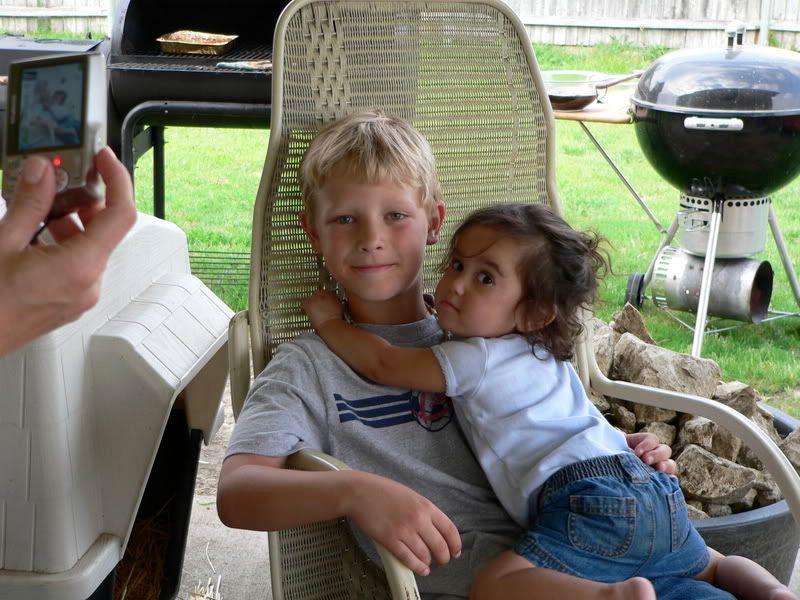
5) Your daughter becomes fixated on a cute, older (by five years!) boy (whom she called “Boy” all evening) and ended up doing this:

So, I ask you; how do you think she’s going to turn out?
:)

Photo: M and "Boy" (2007)

5/21/07

Galatians: Weeks 6 and 7 (well, and 5 too)

Galatians 2:11-21
When Peter came to Antioch, I opposed him to his face for he was clearly in the wrong. Before certain men came from James, he used to eat with the Gentiles. But when they arrived, he began to draw back and separate himself from the Gentiles because he was afraid of those who belonged to the circumcision group. The other Jews joined him in his hypocrisy, so that by their hypocrisy even Barnabas was led astray. When I saw that they were not acting in line with the truth of the gospel, I said to Peter in front of them all, “You are a Jew, yet you live like a Gentile and not like a Jew. How is it, then, that you force Gentiles to follow Jewish customs?” We who are Jews by birth and not Gentile sinners know that a man is not justified by observing the law, but by faith in Jesus Christ. So we, too, have put our faith in Christ Jesus so that we might be justified by faith in Christ and not by observing the law, because by observing the law, no one will be justified. If, while we seek to be justified in Christ, it becomes evident that we ourselves are sinners, does that mean that Christ promotes sin? Absolutely not. If I rebuild what I destroyed, I prove that I am a lawbreaker. For through the law, I died to the law, so that I might live for Christ. I have been crucified with Christ and I no longer live, but Christ lives in me. The life I live in the body, I live by faith in the Son of God, who loved me and gave himself for me. I do not set aside the grace of God, for if righteousness could be gained through the law, Christ died for nothing!

Okay, so I skipped posting last week because I was catching up on my memorization. And I intended to write this post on Friday, and then I blinked...and here we are on Monday. But here we go!

What has struck me about this entire passage and the one before is this: it was Christians causing division in the church. In Week 5’s verses, Paul refers to some “false brothers.” I did some research to find out more about these false brothers, but really didn’t come up with much. But here’s what I surmise...they were Christians. They might have been confused, deluded, or divisive, but I imagine they had good intentions (kind of like those Pharisees). Most likely they were not pagan worshippers who were dressing up like Christians, sneaking into the church and trying to convert people back to the pagan religions. I imagine they were Jewish Christians who were having trouble letting go of their rich history and traditions. I mean, Jewish law governed ALL of life. The “truth of the Gospel” that Paul was preaching rocked their entire system of existing. Paul goes on in this passage to describe what happened with even Peter. Peter, a pillar in the church, also fell prey to the hypocrisy plaguing the early church.

So what I take away are these two main points:
1) Test everything against the truth of the Gospel. Obviously that includes what you’re reading, what you’re seeing on television and what you’re hearing on the radio. But it also includes what your parents say, what your pastor says, what your friends tell you and even what famous, well-respected Christians are saying (and publishing). While they may be well intentioned, they may possibly be wrong. I’m not saying you can’t trust anyone; I am saying to be discerning.

2) Be careful when you begin speaking with authority. I’m definitely guilty of this. We sometimes are quick to share “what the Bible says” when we really don’t know where it says it. Or we quote things we have heard or read, and relay it as if it is truth - only because we assume the person we heard it from must be correct. I don’t want to become a “false brother” who is inadvertently trying to enslave people.

Obviously I could comment on much more from these passages, but this is what I’ve been pondering the past couple weeks. As usual, would love to hear your thoughts.

5/17/07

Dandy-Lines *updated with video*

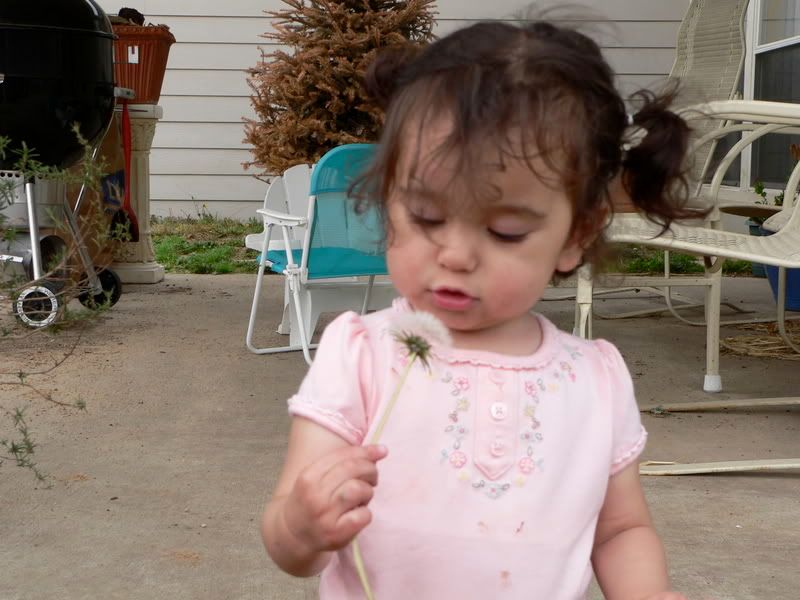
Well, it seems that dandelions have not only launched an assault on my yard, but they are pervasive in the blog-o-sphere right now: Craver’s busy trying to annihilate them, Charity’s reflecting on them and LL is eating them. As I stare out at the new crop peeping up out of the grass in my neighbor’s lawn (the other neighbor recently sent her son over to mow their lawn because it looked so bad, and they’re trying to sell their house), I thought I would join in the ode to dandelions with my own posting.

Over the last couple weeks in our house, here have been a few of my favorite lines - they’re real dandys…

Take Jesus out of your mouth right now.
We don’t eat flamingoes in our house.
Markers are for coloring, not for eating.
Don’t put your face in that puddle! Yucky!
Honey, why are you lying face down in the sand?
You have to say, “Catch, mama” before you jump, not afterwards.
Did she just climb out the back window and on top of her car by herself?

note: for some reason the video hangs up at 4 seconds. so as soon the video starts, advance that little slider below the movie to 5 seconds and you're good.

Any good ones to add?

Book Review - Wishing on Dandelions


And while we're still on the topic of dandelions...here's a book review that I've been meaning to post, and now find it quite appropriate to do so.

If you are looking for a book that stirs your emotions and keeps you up until the wee hours of the morning, then I highly recommend Wishing on Dandelions by Mary DeMuth. WOD is the sequel to DeMuth’s debut novel, Watching the Tree Limbs. Although it took me a little longer to be drawn into this second book, it surpasses the first. WTTL focuses on redemption, and as a natural progression, WOD focuses on learning how to accept God’s love and growing deeper in understanding our redemption.

I found this story heavier that the first book, despite the fact that the main traumatic events occur to Maranatha in WTTL. For me, I identified on a deeper level with the struggle to fully grasp and accept that God loves me despite all my faults. While I enjoyed the first book, I connected more with the second. I appreciated the new characters Mary introduced as well. Some of them I liked immediately, and only wished to know them more. Some of them had to grow on me, but the more glimpses I got into their hearts, the more I wanted to know about their back stories. Still others I appreciated for the reality of their humanity. One character in particular I really thought was going to have a change of heart after he heard Maranatha’s story, but he didn’t. In fact, the depth of the judgment in his soul only became more evident. At first I was appalled, but then quickly realized that people like that do exist and therefore have an appropriate - even necessary - place in a novel like this.

One of the many things I enjoy about Mary’s writing is that while she is a Christian author who discusses Christian values and issues, her books do not feel “Christian.” Do you follow me here? Writing a great story is what comes first for Mary, not writing a Christian story that she hopes is great. Of course, Jesus pours out onto her page, but that’s because He’s so pervasive in her life, not because she has an agenda to write about Him. I applaud her for writing reality, writing authentically and writing with excellence. It’s no wonder she’s nominated for a Christy Award.

5/15/07

Book Review - The Culturally Savvy Christian

*Updated* So really, you don't have to read the book first to comment...if you have any thoughts or reactions based upon what I shared with you about the book or from the quotes, I'd love to hear them!

When was the last time you read a book where you felt like you underlined most of it? For me, it was Dick Staub’s latest book, The Culturally Savvy Christian. I enjoyed Staub’s passionate appeal to Christians to be deep in their faith and relevant to society, both. He leaves no room for it to be an either or decision; it is both.

The underlying premise of the book is encapsulated in this quote:

We live in a superficial popular culture, soulless, spiritually delusional, and driven by celebrity. Today’s Christianity has taken on those same qualities. Because we are created in God’s image, with spiritual, intellectual, creative, moral, and relational capacities, we will never be satisfied with a superficial, mindless culture or religion; the result is that religious and irreligious people alike are experiencing deep spiritual hunger.


Staub then goes on to lay out his response to the question, how then do we change?

1. We must be deep Christians, drinking deeply from the living water, making God the central importance in our lives and the cross the center of our personal story.
2. We must become fully human, which to Staub means allowing God to restore us to His original intent - not salvation or the evangelism of others, but to glorify Him through reflecting His image. This requires that we present our bodies as living sacrifices to Him, stop conforming to the world and renew our minds. Staub also points out that “our call to become fully human is a direction, not a promise of perfection.” We are not done with our changes until we reach heaven.
3. We must love others with an unconditional, transforming love. That love should be embodied in our actions, ideas, beliefs, our public and our private lives.
4. We must be discerning about culture, “discovering points of disagreement between our faith and culture by listening to both, then choosing a path that pleases God.” We must practice “selective acculturation, allowing ourselves to experience resonance with art that connects us with the joy pain and realities of our fellow humans, while also identifying and guarding against dissonant values, ideas, belief and behavior.”
5. We must build community with other believers, because we are all aliens in this world. We long for a place to be encouraged, to fellowship and to belong.
6. We must observe the culture we live in (almost like anthropologists) so that we can find the most effective entry point for each person or group and communicate using an appropriate language and illustrations. We must also care deeply about people. We bridge cultural knowledge to our Christian experience and understanding.

Staub ends with a chapter to artists and creatives, saying they will lead us into the “cultural renaissance” we’ve been waiting for. He offers some good insights and advice to artists (used broadly), particularly around being authentic and striving for excellence, not just trying to be “Christian.” He offers a quote from CS Lewis saying “we don’t need Christian writers, we need great writers who are Christian.”

If I had to cite anything negative about the book, it would be that Staub uses an overwhelming number of quotes (albeit some great quotes), and sometimes references the same quote multiple times. During the first section of the book, he comes off as a little preachy, but I chalk that up to his passion for the topic.

I was pleased that he offered solutions, not just complaints about society and Christianity. I also appreciated his unwavering support of being strong in your faith, and at the same time understanding the culture.

I highly encourage you to pick up this book and read it. When you do, come back and tell me what you think. Personally, I’m excited and energized about being a “culturally savvy Christian.”

A few more quotes (among many, many) I appreciated:
“People who believe they know the truth need to realize that cultural influence requires more than knowing the story; it requires telling it thoughtfully and artistically. Never has there been a greater need for wise, gifted storytellers who understand the story we are in and can communicate a better way gracefully and truthfully.”

“Today, the toughest test we can apply is to ask whether the media items we consume represent the highest and best spiritually, intellectually and aesthetically.”

“Culturally savvy artists do not expect their work to be accepted because they are Christian, but because their art is good.”